

Use AWS Tags in CloudZero
CloudZero allocates costs using metadata already in your AWS bill, including accounts, services, regions, and usage types. If your organization also uses AWS resource tags, you can activate them as cost allocation tags so they appear as filtering and grouping options in the CloudZero Explorer.
To learn how CloudZero organizes cost data from tags and other metadata into business categories, see Overview of Cost Allocation with Dimensions.
What you need
- Access to the management account in your AWS Organization (only the management account can activate cost allocation tags)
- If your team has not started tagging resources, see Tagging AWS resources in the AWS documentation
AWS defines and applies certain tags automatically (prefixed with
aws:), such asaws:createdbyandaws:cloudformation:stack-name. You do not need to create these tags manually, but they may not be activated for cost allocation by default. For details, see Using AWS-generated tags in the AWS documentation.
Step 1: Open Cost Allocation Tags in AWS
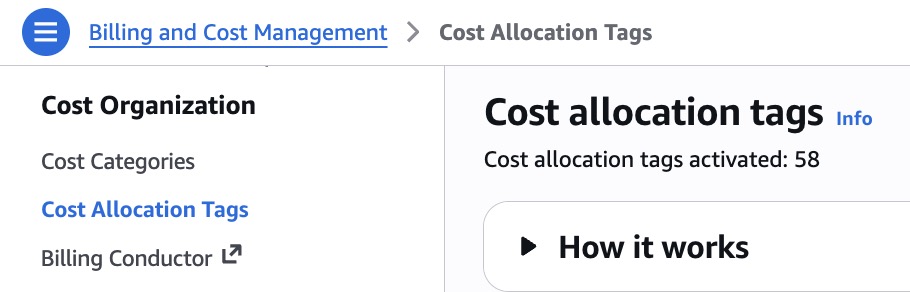
- Sign into your management account in the AWS Billing and Cost Management console.
- In the left navigation under Cost Organization, select Cost Allocation Tags.
Step 2: Activate tags
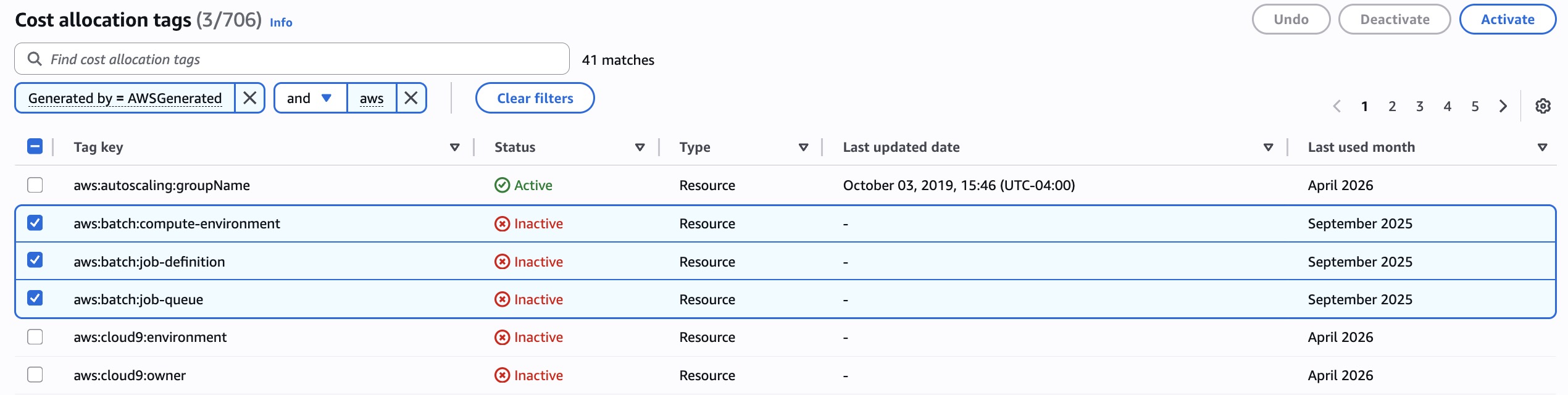
The Cost Allocation Tags page lists all available tags across your organization. Use the search box to find specific tags.
- Search for the tags you want to activate. See the tags to activate section below for common starting points.
- Select the checkbox next to each tag you want to activate.
- Select Activate.
For more details on cost allocation tags, see Organizing and tracking costs using AWS cost allocation tags in the AWS documentation.
Which tags to activate
Any tag that appears on the Cost Allocation Tags page can be activated for use in CloudZero. There are four types:
Your custom resource tags are the tags your team applies to AWS resources. If your organization already tags resources, you can activate those tags here to use them as additional allocation, filtering, and grouping options in CloudZero. Common examples include:
team,department, orcost-centerfor ownershipenvironmentorenvfor separating production, staging, and developmentprojectorapplicationfor tracking costs by initiativeservicefor mapping costs to your organization's own services or products
AWS-generated tags are created by AWS services automatically. If these tags exist in your environment, activating them adds infrastructure-level context to your cost data:
| Tag | What it provides |
|---|---|
Name | The name assigned to individual resources |
aws:createdby | Which IAM user or role created the resource |
aws:autoscaling:groupname | Auto Scaling group membership |
aws:cloudformation:logical-id | The logical resource ID from a CloudFormation stack |
aws:cloudformation:stack-name | Which CloudFormation stack deployed the resource |
aws:ecs:clustername | ECS cluster membership |
aws:ecs:servicename | ECS service membership |
aws:elasticmapreduce:instance-group-role | EMR instance group role (master, core, task) |
aws:elasticmapreduce:job-flow-id | Which EMR job flow the resource belongs to |
eks:cluster-name | EKS cluster membership |
eks:nodegroup-name | EKS node group membership |
aws:ec2spot:fleet-request-id | Spot Fleet request, for tracking Spot instance usage and savings |
Account tags are tags applied to the AWS account itself, such as through AWS Organizations, rather than to individual resources. Activate them the same way as resource tags, using the steps above. CloudZero prefixes each account tag with account: to keep it distinct from a resource tag that shares the same key. For example, an AWS account tagged team: platform appears in CloudZero as the tag account:team, separate from any resource tagged team.
Account tags require a CUR 2.0 connection. CUR 1.0 doesn't carry account-level tag data.
IAM principal tags are tags applied to the IAM role or user that made a request, rather than to a resource. They're useful for services like Amazon Bedrock, where multiple teams often share the same infrastructure and a resource-level tag cannot show who actually drove the cost. To bring an IAM principal tag into CloudZero:
- Connect the account through Cost and Usage Report 2.0 with caller identity (IAM principal) allocation data enabled.
- Apply the tag to the IAM role or user in AWS IAM. See AWS's IAM principal cost allocation documentation for how to create and enable these tags.
- Activate the tag the same way as any other cost allocation tag, using the steps above.
- Contact your account manager to add the tag as a filtering and grouping option in CloudZero.
What to expect
After you activate a resource, AWS-generated, or account tag, AWS includes it in your Cost and Usage Report starting with the next billing period. CloudZero picks up the new tag during the next data ingest, which happens within 24 hours, and it appears as an allocation, filtering, and grouping option in the Explorer. IAM principal tags follow the same activation timeline in AWS, but appear in CloudZero only after your account manager adds them, as described above.
Have questions or feedback? Reach out to your account manager.
Updated 25 days ago