

Connecting to New Relic
Connect your New Relic account to CloudZero to bring your New Relic cost and usage data into a unified view of all your cloud and SaaS spend. CloudZero organizes your New Relic costs, along with your other costs, into categories (called Dimensions) that matter most to your business. For example: business unit, team, product, feature, environment, customer, or virtually anything else. Once connected and organized, you can quickly answer questions about your spend that matter to your stakeholders.
This guide covers creating a New Relic API key and configuring the connection in CloudZero. CloudZero queries your New Relic account directly through the API, pulls cost and usage data across all accounts accessible to your API key, and combines it with pricing details you provide to calculate your New Relic spend.
What you need
- CloudZero user with data configuration permissions
- New Relic account with the Admin role (required to create API keys)
- Your New Relic pricing details (from your contract with New Relic)
Step 1: Create a New Relic API key
For full details, see New Relic's API key documentation.
- In New Relic, navigate to Administration > API Keys.

- Select Create a key.
- Select User as the key type.
- Select your account and enter a name for the key (for example,
CloudZero connection). - Select Create a key and copy the key value.

The connection pulls data for all accounts accessible to the API key. To include all accounts, use an API key associated with your New Relic parent account.
Step 2: Configure the connection in CloudZero
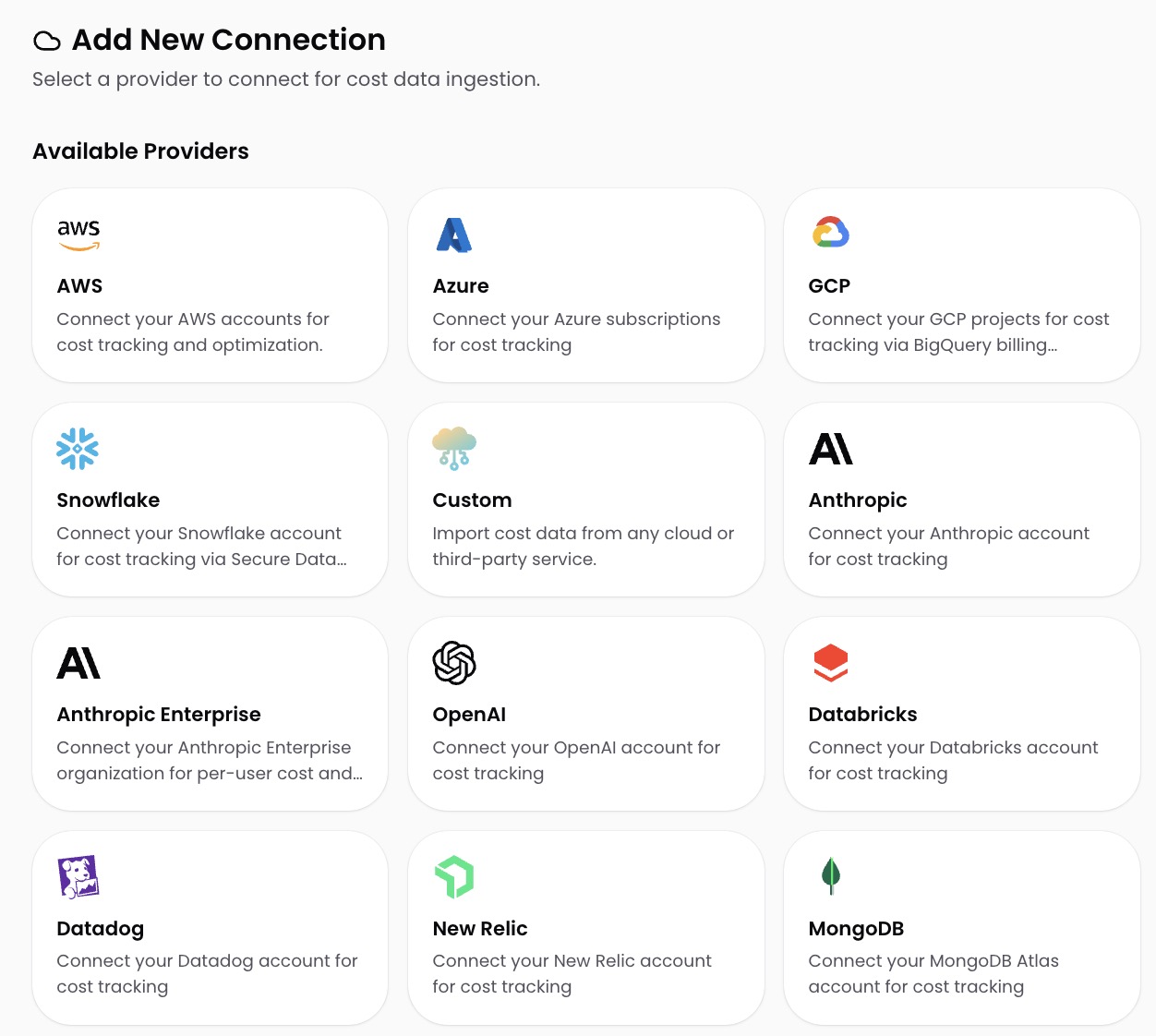
In CloudZero, go to Settings > Connections. Select Create Connection + and select the New Relic tile.
Account information
Enter your New Relic account details. You can find your Billing Account ID and region in Administration > Plan & Usage > Plan summary in New Relic.

| Field | Description |
|---|---|
| Connection Name | A display name for this connection in CloudZero |
| Billing Account ID | Your New Relic parent account ID |
| New Relic Account Region | The region your New Relic account uses (US or EU) |
| API Key | The User API key you created in Step 1 |
Rate information
Enter the rates from your New Relic contract. You can find this information in Administration > Plan & Usage > Plan summary in New Relic.
| Field | Description |
|---|---|
| Subscription Term Start Date | The date your current New Relic contract began |
| Data | Price per GB of data ingested |
| Basic Users | Price per Basic User (typically $0) |
| Core Users | Price per Core User |
| Full Platform Users | Price per Full Platform User |
| Additional Synthetic Checks | Price per Synthetic Check |
If your New Relic agreement includes tiered pricing (rates that change based on usage), select Add Tier for the relevant fields and enter the tier details. Do not account for free usage with tiers (for example, the first 100 GB per month is free).
If your agreement recently changed and you want to calculate historical consumption with your previous rates, contact your account manager.
Select Save to create the connection.
What to expect
After you save the connection, CloudZero begins pulling your New Relic cost and usage data:
- New connection: CloudZero pulls up to 12 months of historical billing data if available.
- Re-enabled connection: CloudZero pulls up to 24 months of billing data, starting from the current period back to the last previously ingested period.
- Steady state: CloudZero pulls the current billing period and sometimes the previous billing period.
Cost data appears in the Explorer within 24 hours.
Connection details
Tags
The New Relic connection includes the following tags for use in Dimensions:
nr_cz:account_name: Name of the account associated with the usagenr_cz:service.nameandnr_cz:service.namespace: Identify the specific service or application generating usage. CloudZero maps these from New Relic event data, as shown in the tables below.
service.name mappings
| Event Type | Facet Field |
|---|---|
Metric | newrelic.source |
Log | plugin.type |
PageView | appName |
PageViewTiming | appName |
AjaxRequest | appName |
BrowserTiming | appName |
JavaScriptError | appName |
PageAction | actionName OR appName |
Span | browserApp.name OR mobileApp.name OR service.name |
NetworkSample | hostname |
StorageSample | hostname |
SyntheticRequest | monitorName |
SyntheticPrivateLocationStatus | name |
MobileSession | newRelicAgent |
Mobile | name |
MobileSession | osName |
MobileHandledException | osName |
MobileCrash | osName |
MobileRequestError | osName |
MobileRequest | osName |
InfrastructureEvent | provider |
SyntheticsPrivateMinion | minionIpv4 |
service.namespace mappings
| Event Type | Facet Field |
|---|---|
Metric | metricName |
Log | syslog.app.name |
Span | appName |
SyntheticRequest | domain |
MobileSession | appName |
MobileHandledException | appName |
MobileCrash | appName |
MobileRequestError | appName |
MobileRequest | appName |
Mobile | device OR deviceType |
InfrastructureEvent | source |
Usage metric groups
CloudZero categorizes your New Relic cost data by usage type (data ingest, users, synthetic checks, etc.). For certain event types, CloudZero also captures the specific source shown in the table below:
| Event Type | Facet Field |
|---|---|
Metric | dataType |
Log | newrelic.source |
NetworkSample | dataType |
StorageSample | agentName |
MobileSession | platform |
MobileHandledException | platform |
MobileCrash | platform |
MobileRequestError | platform |
MobileRequest | platform |
Have questions or feedback? Reach out to your account manager.
Updated about 1 month ago