

Budgets
Budgets let you set monthly spending targets for any View and track actual spend against those targets. When spend crosses a threshold you define, CloudZero sends an alert through the notification channels configured on the View. You can also create Forecasts to track a separate spending target imported from your own planning process.
To access Budgets, select Budgets from the left navigation.
Create a Budget
You can create a Budget by entering details on the Budgets page or by uploading a comma-separated values (CSV) file.
Option A: Use the Budgets page UI
- On the Budgets page, select Create Budget +.
- Select a View from the drop-down menu.
- Set a Start month and End month for the Budget period.
- Choose whether to create a Budget, a Forecast, or both.
- Choose how to enter your target amount:
- Same each month: A single amount for every month in the period
- Split total evenly: A total divided equally across all months
- Custom per month: A different amount for each month
- Review the summary card.
- (Optional) Set alert thresholds from 10% to 100% of the Budget.
- Select Save.
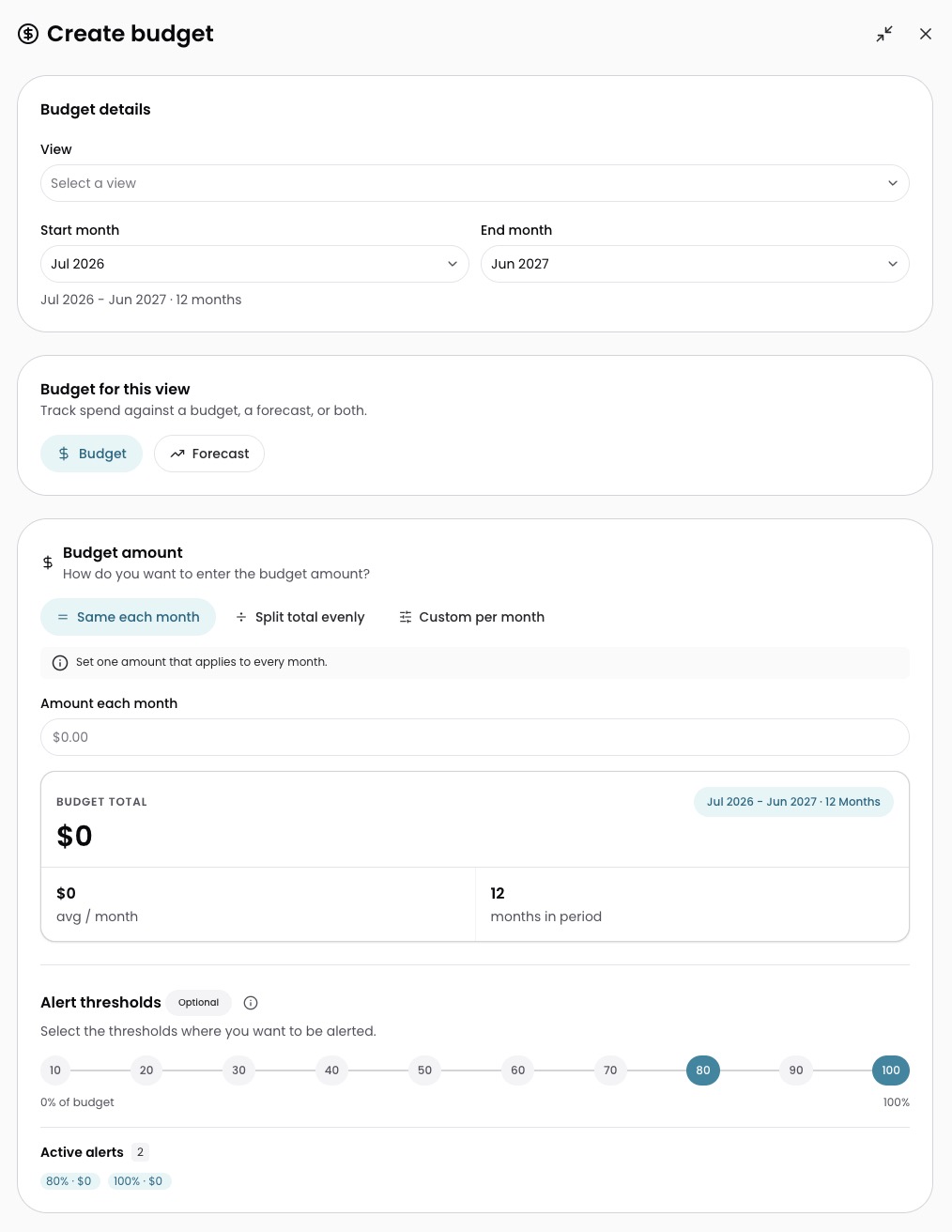
After saving, the Budget appears in the Budgets table and CloudZero begins tracking actual spend against your targets.
Option B: Upload a CSV
Upload a CSV file to create Budgets for multiple Views at once.
Step 1: Generate the Budget template
- On the Budgets page, select Create Budget +.
- Select the CSV upload icon in the bottom left corner.
- In the Generate Budget CSV modal, select the Views to include.
- Check Budgets, Forecasts, or both.
- (Optional) Select the alert threshold percentages to enable (10% to 100%). CloudZero pre-populates selected thresholds as Y in the generated CSV.
- Set a Start month and End month. The maximum date range is 10 years (120 months).
- Select Generate CSV.
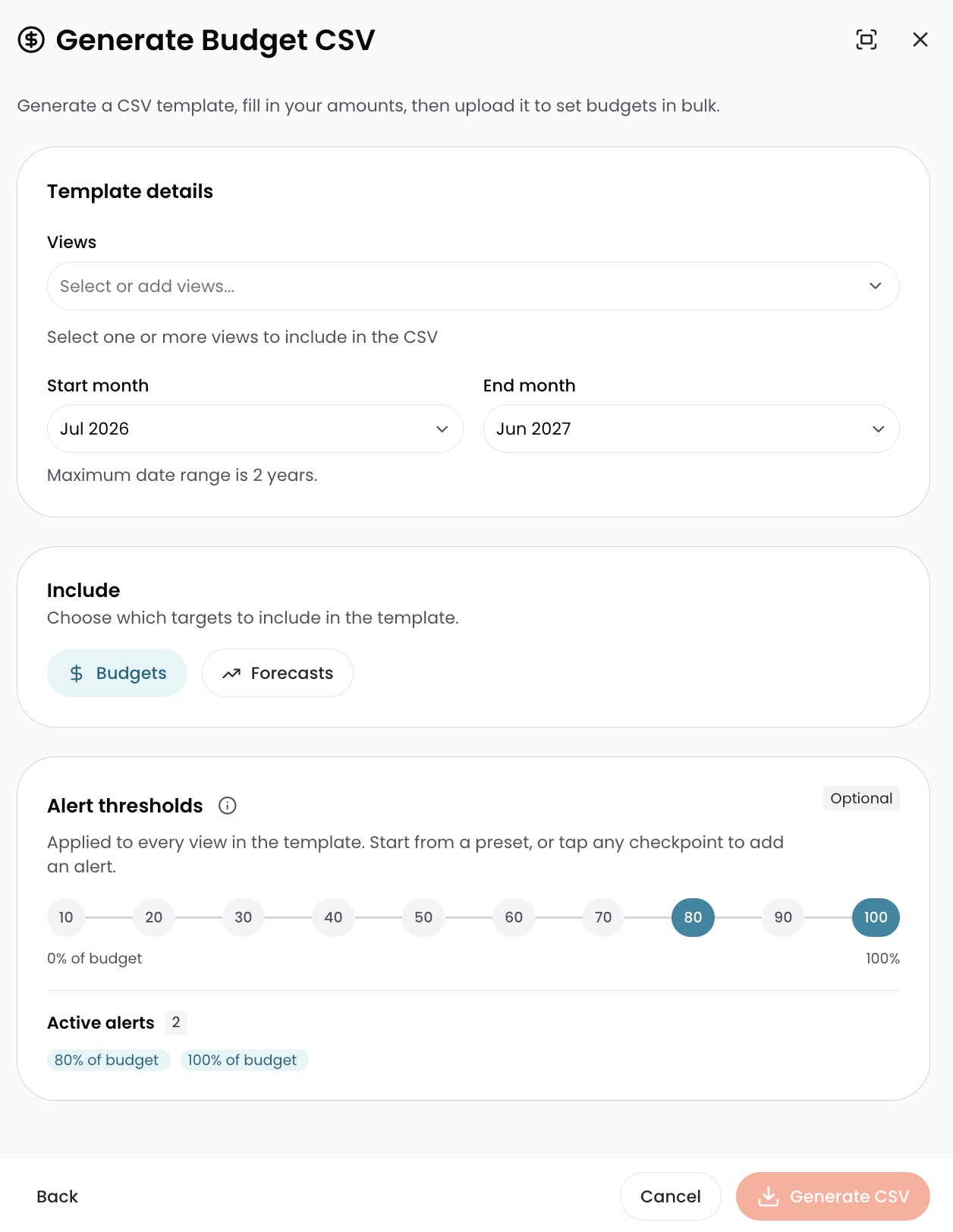
Step 2: Set monthly Budget amounts
The generated CSV has 1 row per View and Budget/Forecast combination, alert threshold columns (10% through 100%) pre-populated with Y or N, and 1 month column per month in your selected date range.
- Open the downloaded CSV file in a spreadsheet tool such as Microsoft Excel, Apple Numbers, or Google Sheets.
- Enter the dollar amount you want to track in each month column.
- (Optional) Adjust the alert threshold columns. Y enables the threshold; N disables it.
- Save your spreadsheet as a CSV file.
Do not add or remove columns or rows.

Step 3: Upload the Budget CSV
- Return to the Upload budgets via CSV screen in CloudZero.
- Drag and drop your CSV file or browse for it.
- Select Create budget.
CloudZero validates the file and creates or updates your Budgets. If a row has an issue, CloudZero identifies it.
After uploading, CloudZero begins tracking actual spend against your targets and sends alerts through each View's notification channels when spend crosses an enabled threshold.
Edit a Budget
You can edit a Budget from the Budgets page or by re-uploading a CSV with updated values.
Option A: Use the Budgets page UI
You can reach the edit form from the table or the detail panel.
From the table:
- Click the three-dot menu in the Actions column, then select Edit budget.
- Update the Budget or Forecast amount, change the entry mode, and adjust alert thresholds as needed.
- Select Save.
From the detail panel:
- Click the View name to open the detail panel.
- Select Edit budget at the bottom of the panel.
- Update the Budget or Forecast amount, change the entry mode, and adjust alert thresholds as needed.
- Select Save.
Option B: Upload a CSV
To update Budgets for multiple Views at once, generate a new CSV template. The template comes pre-filled with your current Budget amounts. Update the values you want to change, save the file, and re-upload it. CloudZero replaces existing values for any matching View and month. Follow the same steps in Create a Budget > Option B: Upload a CSV.
Delete a Budget
- Click the three-dot menu in the Actions column for the Budget you want to delete, then select Delete.
- Confirm the deletion.
You can also delete a Budget from the detail panel by selecting the Delete icon in the toolbar.
Alert thresholds
You set alert thresholds when creating or editing a Budget. Thresholds range from 10% to 100% in 10% increments. CloudZero sends an alert through the notification channels (Slack, email, Google Chat) configured on the View each time spend crosses a threshold. For example, if you enable 80%, 90%, and 100% thresholds, you receive an alert when spend exceeds 80%, another when it exceeds 90%, and another when it exceeds 100%.
You can configure thresholds in 3 places:
- In the Create Budget or Edit Budget form: Select thresholds visually on the slider.
- In the Generate Budget CSV modal: Select thresholds visually before generating the template.
- In the CSV: Change the Y or N value in each threshold column.
For details on setting up notification channels, see Notifications.
What the Budgets page shows
The Budgets page lists all Budgets and Forecasts across your organization. Use the filter tabs to switch between All, Configured, and Not Set entries, or use the Search bar to find a specific View.
The results table shows:
- View: The View the Budget or Forecast is linked to
- Spend: Actual spend for the current month
- Budget: The Budget amount set for the current month
- Forecast: The Forecast amount set for the current month, if configured
- % Used (Budget): Percentage of the Budget consumed, color-coded to indicate whether spend is on track, approaching the target, or over budget
- % Used (Forecast): Percentage of the Forecast consumed, color-coded the same way
- Actions: A three-dot menu with options to edit or delete the Budget
From the toolbar, select Export to download data, Customize Table to choose which columns appear, or Create Budget + to add a new Budget.
View Budget details
Click a View name to open the detail panel.
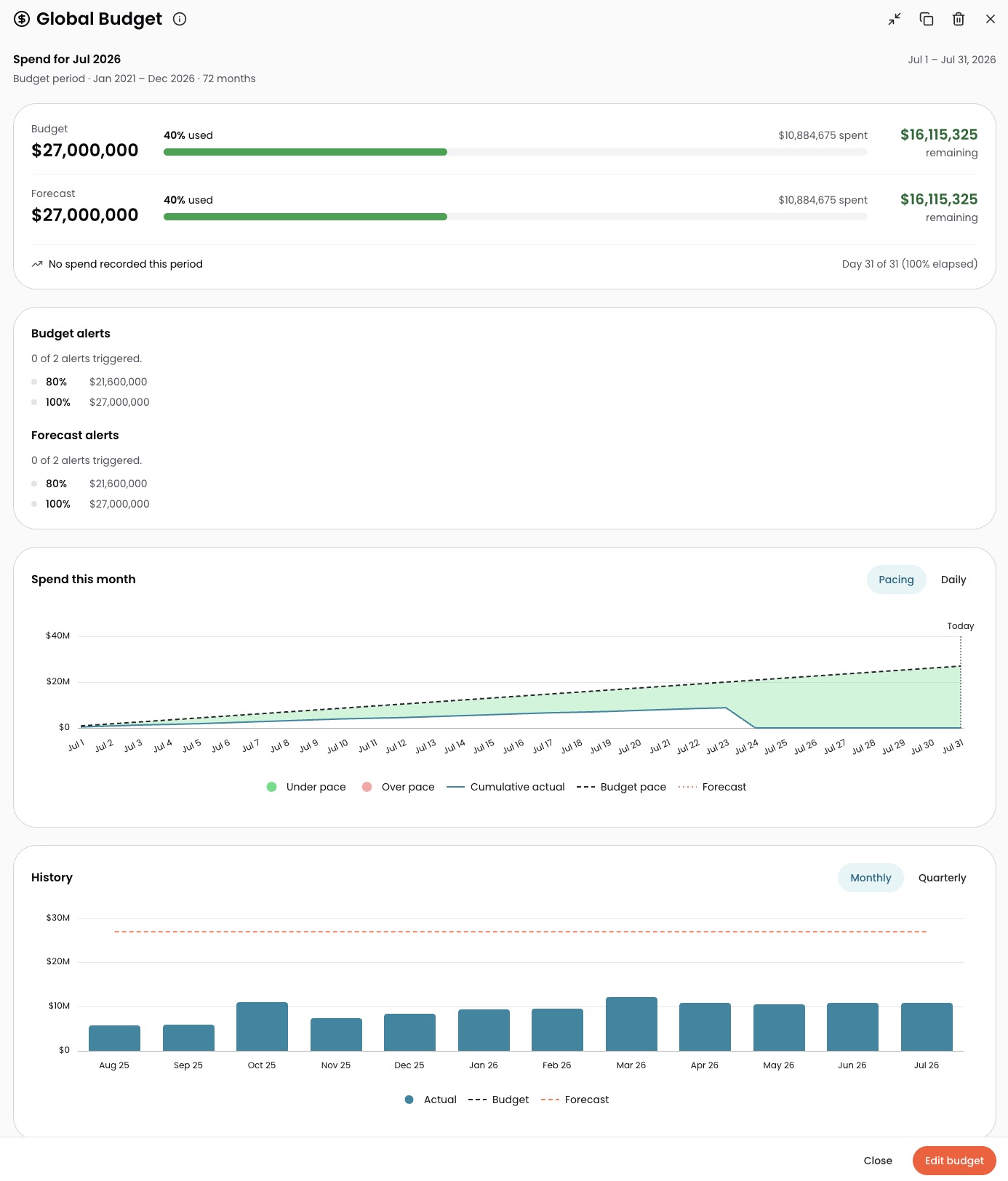
The detail panel shows:
- Budget: The Budget target for the current month, a progress bar showing percentage used, the dollar amount spent so far, and how much spend is over or under the target.
- Forecast: The Forecast target for the current month. If no Forecast is configured, this row displays "Not set" and an Add forecast button.
- Budget alerts and Forecast alerts: The number of triggered alert thresholds (for example, "0 of 2 alerts triggered"), with each threshold percentage and the dollar amount it represents.
- Spend this month: A cumulative spend chart for the current month. Use the Pacing view to see projected spend through end of month, or switch to Daily for day-by-day totals.
- History: Actual spend (bars) compared to the Budget target (dashed line) over past months. Switch between Monthly and Quarterly views.
The toolbar at the top of the detail panel includes icons to expand, copy (duplicates the Budget), delete, and close. At the bottom, select Edit budget to modify the Budget, or select Close to dismiss the panel.
Have questions or feedback? Reach out to your account manager.
Updated about 2 months ago