

CloudZero uses key-based authorization to secure API access. To authenticate your requests, include your API key in the Authorization header:
curl -X GET https://api.cloudzero.com/v2/insights \
-H "Authorization: AbCd1234EfGh5678AbCd1234EfGh5678AbCd12"This is not a bearer token, so there is no
Bearerprefix in the Authorization header.
Manage API keys
An organization can have multiple API keys. To view and manage all API keys for your organization, navigate to Settings > API Keys.
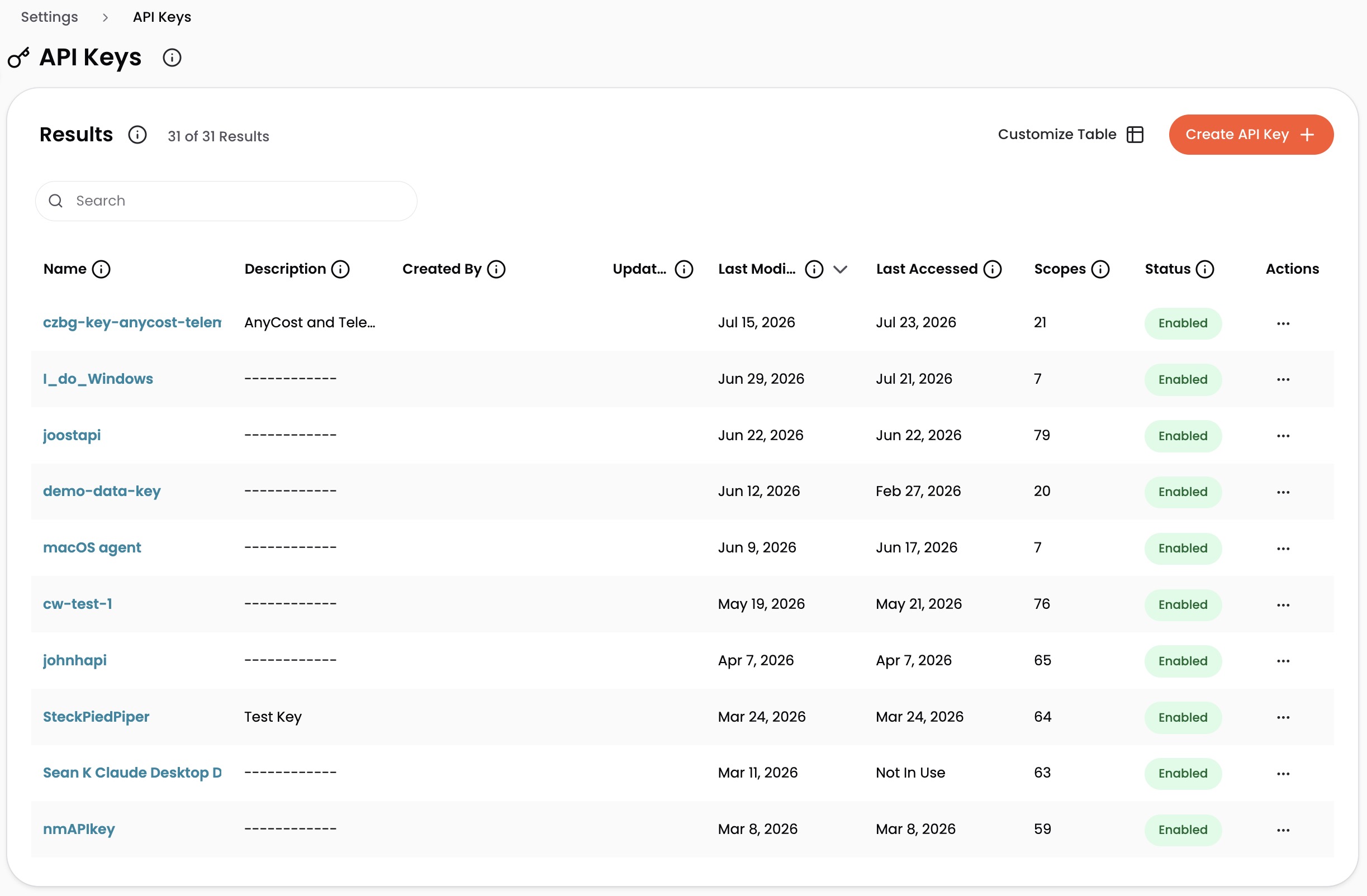
Only users with the necessary permissions can manage keys. Each key can be assigned one or more API scopes, which grant access to specific endpoints in the CloudZero API.
The API Keys page displays a list of keys with the following information:
- Name
- Description
- Created By: Email of the user who created the key
- Updated By: Email of the user who last modified the key
- Last Modified: Last update timestamp
- Last Accessed: Last usage timestamp, or "Not In Use" if the key has never been used
- Scopes: Number of granted API scopes
- Status:
EnabledorDisabled
If your organization had an API key before multiple keys were supported, it is listed as Legacy API Key.
For keys that use fixed scopes, CloudZero does not automatically grant access to new API endpoints. When new endpoints are released, you must edit each key to manually add the necessary scopes. Keys that use managed scopes stay current on their own.
Create an API key
-
Navigate to Settings > API Keys.
-
Select Create API Key.
-
Enter a name for the key (minimum 3 characters, must be unique).
-
Enter a description (optional).
-
Under Scopes, choose how the key is scoped. See Fixed and managed scopes for which to pick.
- Managed scopes: select one or more use cases, such as Send AI Telemetry. CloudZero keeps the key's scopes current as new endpoints ship.
- Fixed scopes: select each scope individually. You must select at least one. Use the search bar or expand categories to find specific scopes. For information about each scope, refer to API key scopes.
-
Select Create API Key.
-
Copy the API key displayed. It will not be shown again.
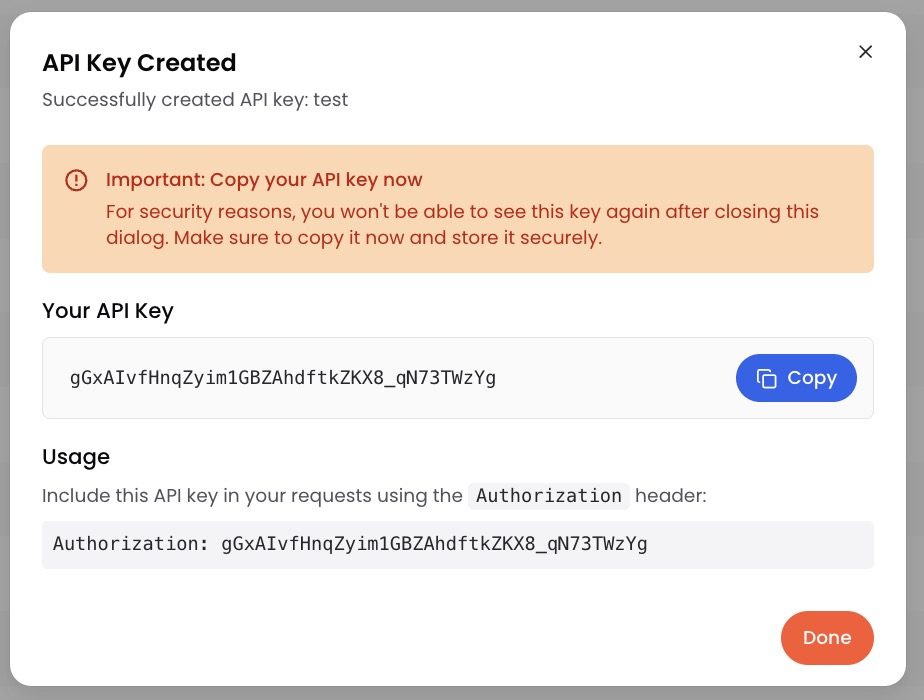
- Select Done.
New keys are Enabled by default.
Edit an API key
- On the API Keys page, locate the key you want to modify.
- Click the key name, or select the three-dot icon in the Actions column and select Edit.
- Modify the Name, Description, or Scopes as needed. For information about each scope, refer to API key scopes.
- Select Save Changes.
Enable or disable an API key
- On the API Keys page, locate the key you want to modify.
- Select the three-dot icon in the Actions column.
- Select Enable or Disable.
The Status column updates to reflect the change.
Delete an API key
Deleting an API key immediately revokes access for any services using it. This action cannot be undone.
- On the API Keys page, locate the key you want to delete.
- Select the three-dot icon in the Actions column.
- Select Delete.
- Type the exact name of the API key to confirm deletion.
- Select Delete.
Fixed and managed scopes
Every API key is scoped one of two ways. A key uses either fixed scopes or managed scopes, never both.
Managed scopes grant a use case rather than a list of endpoints. You select Send AI Telemetry or Send Billing Data, and CloudZero maintains the underlying scopes for you. When a new endpoint ships within that use case, keys already referencing it gain access without any edit. This is the better choice for send-only integrations, where the alternative is discovering later that a key was silently missing an endpoint added after it was issued.
Managed scopes are offered only for use cases that exclusively accept data. These endpoints return nothing about your organization beyond whether a submission was accepted, so widening one cannot expose data a key could not already send.
| Use case | What it grants |
|---|---|
| Send AI Telemetry | Ingest AI inference telemetry from any source. |
| Send Billing Data | Send billing data to an already-established connection. |
Fixed scopes grant exactly the scopes you select and nothing more. New endpoints are never added automatically, so a key keeps the same permissions until you edit it. Choose fixed scopes when a key reads organization data, when you need permissions narrower than a whole use case, or when an audit requires the grant to be an explicit, unchanging list.
API key scopes
The scopes below apply to keys that use fixed scopes. CloudZero organizes them into categories. Each scope grants access to specific API endpoints. When creating or editing an API key, select the scopes that match how the key will be used.
Send AI Telemetry
Ingest AI inference telemetry from any source.
- AI Telemetry (all sources) (
ai-telemetry-ingest:ingest-ai-telemetry): Send AI inference telemetry to any CloudZero ingest endpoint. Grants write access only; it returns nothing about your organization beyond whether a submission was accepted. One scope covers every source, including LiteLLM, Bifrost, OpenTelemetry, Claude Code, and the CloudZero Collector.
Cost & Usage Data
Read cost, usage, dimension, and resource-tag data via the API.
- Read Cost Data (
billing:read_costs) — reference - Read Dimensions (
billing:read_dimensions) — reference - Read Resource Tags (
billing:read_resource_tags)
Views
Create, read, update, and delete saved Views.
- Create Views (
views:create_view) — reference - Delete Views (
views:delete_view) — reference - Read a View (
views:read_view) — reference - List Views (
views:read_views) — reference - Update Views (
views:update_view) — reference
Budgets
Create, read, update, and delete budgets.
- Create Budgets (
budgets:create_budget) — reference - Delete Budgets (
budgets:delete_budget) — reference - Read a Budget (
budgets:read_budget) — reference - List Budgets (
budgets:read_budgets) — reference - Update Budgets (
budgets:update_budget) — reference
Insights & Anomalies
Create, read, update, and comment on cost anomalies and insights.
- Create Insights (
insights:create_insight) — reference - Comment on Insights (
insights:create_insight_comment) — reference - Delete Insights (
insights:delete_insight) — reference - Read an Insight (
insights:read_insight) — reference - Read Insight Comments (
insights:read_insight_comments) — reference - List Insights (
insights:read_insights) — reference - Update Insights (
insights:update_insight) — reference - Update Insight Comments (
insights:update_insight_comment) — reference
Optimization & Savings
Read and manage savings recommendations and their comments.
- Check Optimization Access (
optimize:check) - Comment on Recommendations (
optimize:create_comments) — reference - Delete Recommendation Comments (
optimize:delete_comment) — reference - Read Optimization Dimensions (
optimize:get_available_dimensions) - Read a Recommendation (
optimize:get_recommendation) — reference - Read a Recommendation Type (
optimize:get_recommendation_type) - List Recommendation Comments (
optimize:list_comments) — reference - List Recommendation Types (
optimize:list_recommendation_types) — reference - List Recommendations (
optimize:list_recommendations) — reference - Update Recommendation Comments (
optimize:update_comment) — reference - Update Recommendation Types (
optimize:update_recommendation_type) — reference - Update Recommendations (
optimize:update_recommendations) — reference
Cost Allocation (CostFormation)
Manage CostFormation definitions, namespaces, and publish jobs for cost allocation.
- Cancel Publish Jobs (
costformation:cancel_publish_job) — reference - Create Definitions (
costformation:create_definition_async) — reference - Create Definition Versions (
costformation:create_definition_version) — reference - Create Namespaces (
costformation:create_namespace) — reference - Create Namespaced Definitions (
costformation:create_namespaced_definition_async) — reference - Delete Namespaces (
costformation:delete_namespace) — reference - List Publish Jobs (
costformation:list_publish_jobs) — reference - List Namespaces (
costformation:read_all_namespaces) — reference - Read a Definition Version (
costformation:read_definition_version) — reference - List Definition Versions (
costformation:read_definition_versions) — reference - Read a Namespace (
costformation:read_namespace) — reference - Read a Publish Job (
costformation:read_publish_job) — reference - Update Namespaces (
costformation:update_namespace) — reference
Kubernetes Agent
Send-only permissions for the CloudZero Kubernetes agent to upload container metrics.
The agent also requires the List Insights permission (listed under Insights & Anomalies) to validate its API key at startup. This is an authentication liveness check only — it is not used to read cost data — and is the only read the agent needs.
- Abandon Metric Uploads (
container-metrics_v1:abandon) — guide - Read Metric Upload Status (
container-metrics_v1:get-status) — guide - Legacy Metric Upload (
container-metrics_v1:legacy) — guide - Upload Container Metrics (
container-metrics_v1:upload) — guide
Kubernetes Clusters
Read and manage CloudZero Kubernetes cluster configuration. Not required by the Kubernetes agent to send data.
- List Clusters (
container:get-clusters) - Update Clusters (
container:update-cluster)
Send Billing Data
Send billing data to an already-established connection.
- Send AnyCost Billing Data (
connections:create_billing_anycost_billing_drop) — reference - Validate AnyCost Billing Data (
connections:create_billing_anycost_validate_billing_drop) — reference
Manage Billing Connections
Create, read, update, and delete cloud billing connections, and check the status of AnyCost billing drops.
- Create Billing Connections (
connections:create_billing) — reference - Delete Billing Connections (
connections:delete_billing) — reference - Read a Billing Connection (
connections:read_billing) — reference - List AnyCost Billing Drops (
connections:read_billing_anycost_billing_drops) — reference - List Monthly AnyCost Billing Drops (
connections:read_billing_anycost_billing_drops_month) — reference - List Billing Connections (
connections:read_billings) — reference - Update Billing Connections (
connections:update_billing) — reference
AI Hub (MCP)
Access the CloudZero AI Hub over MCP for AI assistants and agents.
- AI Hub (MCP) Access (
ai-hub:mcp) — guide
AI Device Control Plane
Enroll AI telemetry devices and report their liveness.
- Enroll Devices (
ai-control-plane:enroll-device) - Send Device Heartbeats (
ai-control-plane:heartbeat-device) - Ping Devices (
ai-control-plane:ping-device)
Telemetry & Usage Streams
Create and manage unit-cost telemetry streams and send usage events.
- Send Usage Events (
events_v1:create_event) — reference - Create Telemetry Streams (
unit-cost_v1:create_telemetry_stream) - Delete Telemetry Streams (
unit-cost_v1:delete_telemetry_stream) — reference - Manage Telemetry Records (
unit-cost_v1:manage_telemetry_records) — post, sum, replace, and delete records for both allocation telemetry and unit cost metric telemetry streams - Read Telemetry (
unit-cost_v1:read_telemetry) — read telemetry stream records and metrics records
Roles & Access Control
Manage CloudZero roles and read permission sets via the API.
- Create Roles (
access-control:create_role) — reference - Delete Roles (
access-control:delete_role) — reference - Read Permission Sets (
access-control:read_permission_sets) — reference - Read a Role (
access-control:read_role) — reference - List Roles (
access-control:read_roles) — reference - Update Roles (
access-control:update_role) — reference
If you need help, contact your account manager.